
Search Paulding County Court Records
The main county route starts with the Paulding County CASE SEARCH instructions. That county page points users to the Clerk case-management system and gives the exact criminal search formats that matter most when a name search fails. For Superior Court and State Court records, the Clerk of Superior Court and the Clerk of State Court are the local record offices. The court records portal is linked from county pages, but older files, sealed files, non-public juvenile matters, and certified copies still require clerk contact.
Paulding County court records are not all in one bucket. Felony, divorce, equity, land-title, and broad civil records are Superior Court records. Misdemeanor, traffic, and some civil records are State Court records. Small claims, dispossessory cases, garnishments, bad checks, ordinance matters, warrants, and first appearances may involve Magistrate Court. Probate Court handles estate, guardianship, conservatorship, marriage, vital-record, passport, and weapons carry functions, and the research did not locate a local online probate docket search.
- Identify the court from the ticket, summons, filing, case number, or agency paperwork.
- Use the county case-management link for Superior Court or State Court records when the matter belongs there.
- For criminal cases without a number, enter the name as last name comma first name, such as Doe, John.
- For a known criminal case number, include the dashes and the full six-digit sequence, such as 21-CR-000001.
- Open the matching case and use the green plus sign to view pleadings when the portal exposes them.
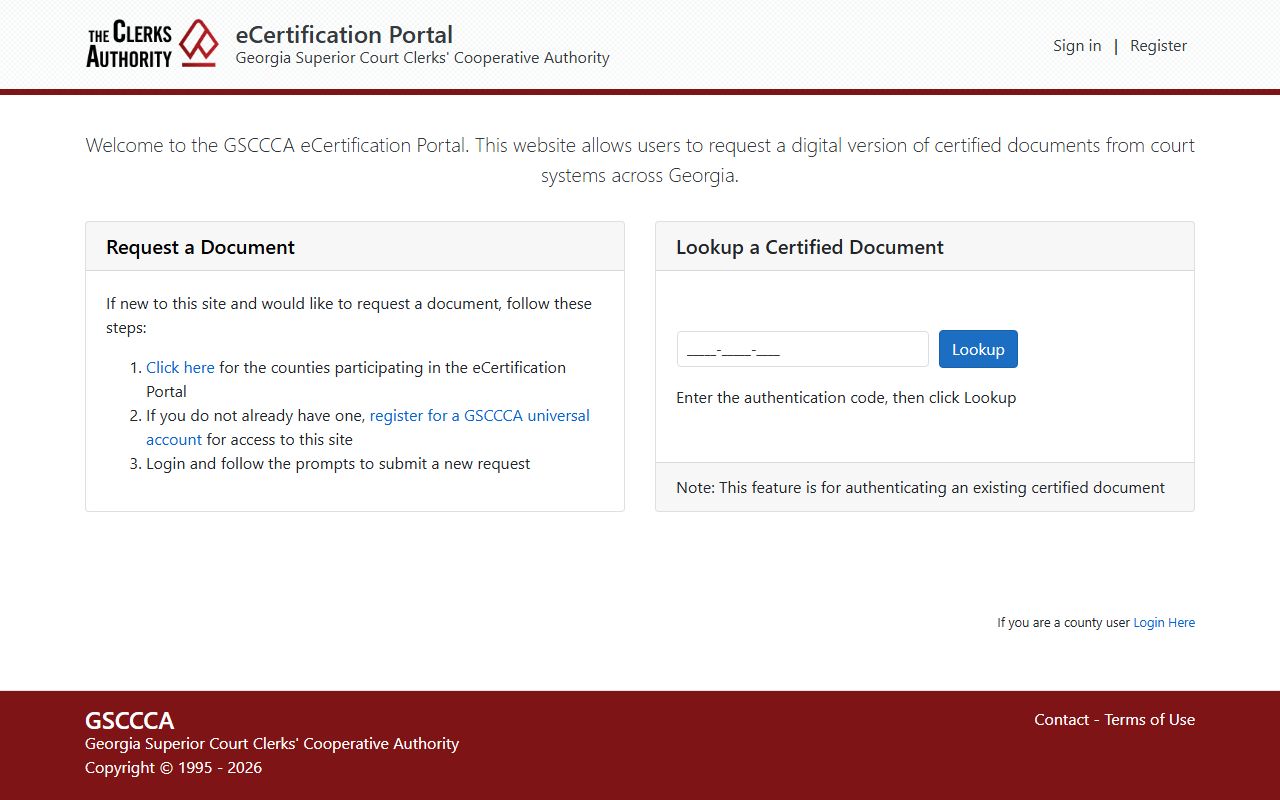
- Request a certified electronic copy through GSCCCA eCertification when a certified digital court document is needed.
The official county case-search instruction page shows how Paulding County expects criminal case searches to be formatted.
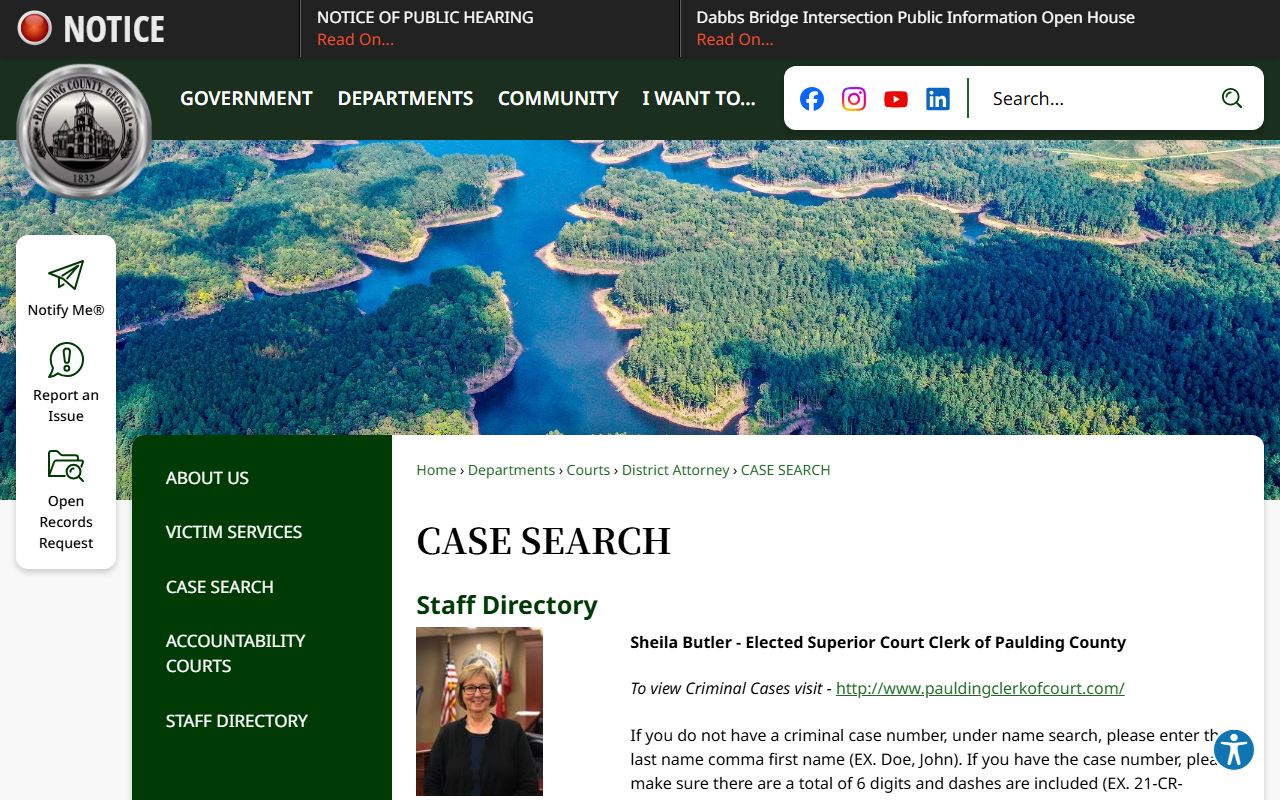
Paulding County Court Records Search Fields
The public portal itself blocked command-line inspection during research, but the county instruction page captured the key fields and result action. That matters because a small format error can hide a real case. Paulding County says criminal case numbers must include dashes, and the example uses a year, case-type code, and a six-digit sequence. Name searching also has a local format, so a first-name-first search may miss the target case.
| Field Label | Type | Required | Notes / Format |
|---|---|---|---|
| Name Search | Text | No, if case number is known | Use last name comma first name for criminal cases, such as Doe, John. |
| Case Number | Text | No, if name is used | Use the full dashed format shown by the county, such as 21-CR-000001. |
| Green plus sign | Result action | N/A | Click the plus sign to the left of the case to view pleadings when available. |
Certified copy requests use a different system. The GSCCCA eCertification portal lets users request certified digital documents through an account and verify an existing certified document with its document code.
Types of Paulding County Court Records
Paulding County court records reflect Georgia's court structure. Superior Court is the general jurisdiction court for felony criminal cases, divorce, equity, title-to-land matters, broad civil litigation, and appeals from lower courts when Georgia law allows. State Court handles misdemeanor criminal cases, traffic citations, and civil matters that overlap with Superior Court except where Superior Court has exclusive jurisdiction. Magistrate Court handles many practical filings that users often think of as court records, including small claims up to $15,000, dispossessory cases, garnishments, pre-warrant applications, bad checks, abandoned motor vehicle matters, and ordinance or animal-control cases.
Some Paulding County records should be searched outside the main case portal. Probate Court is the office for estates, wills, guardianships, conservatorships, marriage licenses, weapons carry licenses, passports, and vital records. Juvenile Court matters have restricted access, and the court directs users to the Juvenile Clerk rather than public judge contact. Sheriff incident, accident, proof-of-incarceration, and arrest reports are not court pleadings. Those records use the Sheriff's Records Division open-records process.
- Civil records may include complaints, answers, motions, orders, judgments, garnishments, and dispossessory filings.
- Criminal records may include charges, indictments, accusations, pleas, motions, verdicts, sentences, and probation orders.
- Family records include divorce and related custody or support filings in Superior Court, with redactions where required.
- Probate records include wills, estate petitions, letters, inventories, guardianships, conservatorships, and orders.
- Traffic records usually begin in State Court unless the citation names a municipal court or a jury demand moves the case.
What Paulding County Court Records Show
A Paulding County court record is usually a mix of index data, docket entries, and filed documents. The index helps identify the case. The docket shows the timeline. The pleadings and orders show what parties filed and how the judge ruled. Criminal records add charge, plea, disposition, and sentence data. Civil records focus on parties, claims, service, motions, orders, judgments, and costs. Traffic records can include the citation number, driver's license search data, payability, court date, fine status, and disposition.
| Field | What It Shows |
|---|---|
| Case number | The local case identifier, including criminal formats like 21-CR-000001. |
| Parties | Plaintiff and defendant, state and defendant, petitioner and respondent, or probate parties. |
| Court | The court that created the record, such as Superior, State, Magistrate, Probate, Juvenile, or Municipal Court. |
| Status | Open, pending, disposed, transferred, appealed, sealed, restricted, or dead docket where shown. |
| Docket entries | Filings, hearings, continuances, notices, warrants, motions, pleadings, orders, pleas, verdicts, or judgments. |
| Financial data | Court costs, fines, bond, restitution, service fees, copy fees, or certification costs. |
| Redactions | Removed or masked data, such as Social Security numbers, account numbers, minor names, or sealed material. |
Paulding County Court Records Access Rules
Georgia starts from a public-access presumption, but not every record is open in full. The Georgia Open Records Act covers county agency records and sets inspection, copy, timing, and fee rules. For court files, Uniform Superior Court Rule 21 states that court records are public unless access is limited by law or procedure. Paulding County users should still start with the office that made or keeps the record, because a court file and a sheriff report are different records held by different offices.
The Sheriff's public records page is relevant when a court case began with a law-enforcement event. It cites O.C.G.A. 50-18-71(c)(1) for search, retrieval, and redaction charges. The first quarter hour is not charged, then the office may charge the prorated hourly salary of the lowest paid qualified employee. Letter and legal copies are 10 cents per page, while accident reports requested at the Sheriff's Office cost $5 cash. Court copies through Magistrate Court have their own amounts: 50 cents per page for copies, and certified Magistrate copies are $2.50 for the first page plus 50 cents for each additional page.
Note: Certified copies should be requested from the clerk or GSCCCA, not printed from a public search screen.
Restricted Paulding County Court Records
Some Paulding County court records are public only in part, or not public at all. Juvenile dependency and delinquency records are restricted, and Juvenile Court directs contact through the Clerk's Office. Adoption files are not ordinary public court records. Mental health proceedings often contain medical and privacy material. Court files can also have redacted identifiers, protected health information, victim information, financial account numbers, minor names, and sensitive law-enforcement details.
Georgia uses the term record restriction for many matters that people call expungement. The GBI criminal-history record restriction page explains O.C.G.A. 35-3-37 and the role of the prosecutor for eligible records. For arrests after July 1, 2013, GBI says there is no GBI application process and the person contacts the prosecutor. For older arrests, the person applies with the arresting agency. In Paulding County, a court-related request may also require the court where the case was filed.
- Docket
- The chronological list of case events, filings, hearings, and orders.
- Pleading
- A formal document filed by a party, such as a complaint, answer, accusation, motion, or petition.
- Disposition
- The final outcome of a charge or case, such as dismissed, guilty, not guilty, or judgment entered.
- Record restriction
- Georgia's term for limiting access to eligible criminal-history records for non-criminal justice purposes.
Paulding County Court Records Requests
When the online system does not answer the question, the fallback is direct office contact. The Clerk of Superior Court and Clerk of State Court share the public case phone number and Room 1023 location at the courthouse. Magistrate Court and Probate Court have separate rooms and phone numbers. For court records, bring or provide the case number if known, party names, court name, case type, and date range. For law-enforcement records tied to an arrest or incident, use the Sheriff's Records Division request route instead of the clerk.
Clerk of Superior Court
280 Constitution Boulevard, Room 1023
Dallas, GA 30132
770-443-7527
Monday-Friday, 8 a.m.-5 p.m.
Sheriff's Records Division
180 Constitution Boulevard
Dallas, GA 30132
770-443-3010
Monday-Friday, 8 a.m.-4:30 p.m.
For hearing dates and event lists, the separate Paulding County court dockets resource is a better fit than a certified copy request. For full criminal case outcomes, use the criminal case file rather than the arrest report alone.